

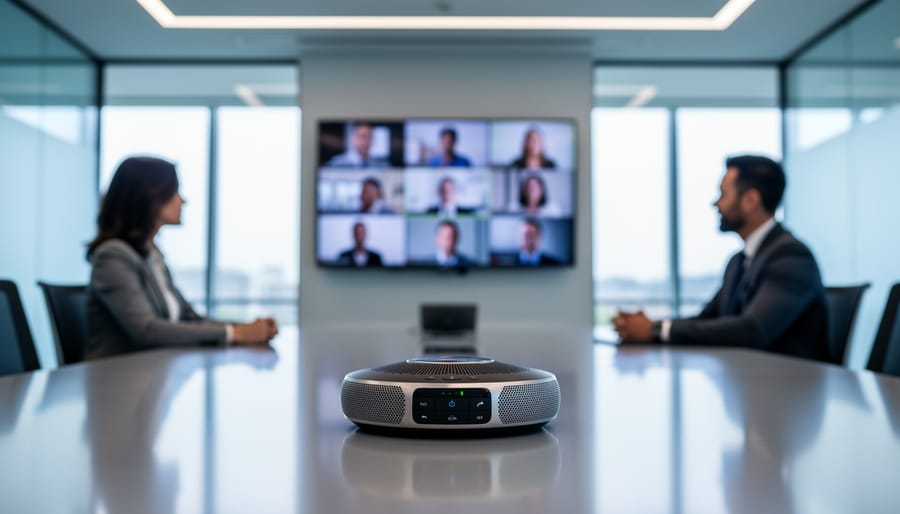
Business video conferencing systems in 2026 range from $500 portable setups to $50,000+ enterprise installations, with the right choice depending on your room size, participant count, and integration requirements. Most businesses find their sweet spot in the $3,000-$15,000 range, where quality cameras, reliable audio, and intuitive software meet without overinvesting in features you won’t use.
The decision matters because poor video conferencing technology derails meetings, frustrates clients, and wastes the time of everyone involved. A pixelated feed or garbled audio during a crucial presentation reflects poorly on your business, regardless of how polished your content may be. Conference venues and corporate facilities that invest in proper systems see higher booking rates and client satisfaction, particularly when boardroom spaces need to accommodate hybrid teams spread across multiple locations.
This guide walks you through the four main system categories, from huddle room solutions to executive boardroom installations, with specific criteria for matching technology to your space. You’ll learn which features actually improve meeting outcomes versus marketing buzzwords, how to avoid compatibility headaches between platforms, and what questions to ask vendors before signing a contract. Whether you’re outfitting a new boardroom facility or upgrading an existing setup, the framework here helps you cut through vendor sales pitches and focus on what delivers reliable performance for your specific meeting patterns and budget constraints.
What Matters Most When Selecting Video Conferencing Solutions

Selecting the right video conferencing solution starts with understanding which factors genuinely affect your daily operations. Too many businesses focus on flashy features while overlooking the fundamentals that determine whether your team actually uses the system or abandons it after the first frustrating call.
Audio quality deserves first priority, even above video clarity. Poor audio disrupts meetings more than grainy video because participants strain to hear, miss key points, and disengage quickly. Look for systems with noise cancellation, echo reduction, and clear transmission even when bandwidth dips. In boardroom settings, invest in directional microphones that pick up voices evenly across the table rather than forcing everyone to cluster around a single device.
Video quality matters most for client-facing presentations and visual collaboration. Standard HD (720p) works fine for internal meetings, but 1080p or 4K becomes valuable when showcasing products, reviewing designs, or hosting stakeholders in professional conferencing facilities. Frame rate stability beats resolution when your internet connection varies, consistent 30fps at 720p outperforms choppy 1080p that freezes mid-sentence.
Ease of use determines adoption rates across your organization. Systems that require IT support to launch a meeting or multiple clicks to share a screen get bypassed for simpler alternatives. The best solutions let participants join with one click, share content instantly, and manage basic controls without consulting a manual. This simplicity becomes crucial in boardroom environments where clients or partners need to connect without technical assistance.
Integration capability affects workflow efficiency more than most businesses anticipate. Your video conferencing should work seamlessly with your calendar system, project management tools, and file storage. Single sign-on prevents password friction, calendar integration eliminates manual meeting setup, and cloud storage integration lets you share documents without switching platforms mid-meeting.
Security features protect both intellectual property and client confidentiality. End-to-end encryption, waiting rooms, password protection, and host controls prevent unauthorized access. Businesses hosting sensitive discussions in boardrooms need systems with compliance certifications relevant to their industry, HIPAA for healthcare, SOC 2 for financial services, GDPR for European operations.
Scalability ensures your investment grows with your needs rather than becoming obsolete. Systems should handle your current team size while accommodating growth, support both small huddles and company-wide broadcasts, and allow adding boardroom hardware without replacing your entire infrastructure. Cost structure matters here: per-user pricing that seems affordable for ten people becomes expensive at fifty.
Types of Business Video Conferencing Systems Compared
Cloud-Based Platforms
Cloud-based platforms deliver video conferencing through your web browser or a lightweight app, eliminating the need for expensive dedicated hardware in your boardroom. Services like Zoom, Microsoft Teams, and Google Meet operate on a subscription model, typically charging per user per month with tiered feature sets.
The primary advantage is immediate deployment: your team can start hosting meetings within minutes of signing up, with automatic updates handled by the provider. This makes cloud platforms ideal for businesses without in-house IT staff or those seeking flexibility as team sizes fluctuate. Participants can join from any device with an internet connection, supporting both remote workers and clients visiting physical meeting spaces.
However, cloud solutions depend entirely on reliable internet connectivity. A venue planning to offer professional meeting services should review our conferencing facility guide to understand how bandwidth requirements affect boardroom capabilities. You’ll also face ongoing subscription costs that compound as your organization grows, and sensitive business discussions will traverse third-party servers, requiring careful evaluation of each provider’s security protocols and data handling practices.
On-Premise Systems
On-premise video conferencing systems involve dedicated hardware installed directly in your boardroom facilities, giving you complete control over the infrastructure. These solutions make the most sense when your business conducts frequent high-stakes meetings in fixed locations and requires maximum security for sensitive discussions.
The primary advantage is data control. Everything stays within your network, no third-party servers handling confidential client presentations or strategic planning sessions. For financial institutions, legal firms, and healthcare organizations with strict compliance requirements, this architecture eliminates many regulatory concerns about data traveling through external platforms.
You’ll need significant upfront investment in equipment like codec systems, professional cameras, microphones, and dedicated displays. Expect maintenance costs and technical staff to manage the infrastructure. Installation requires proper network configuration and often specialized training for your team.
This approach works best for established businesses with permanent boardroom spaces hosting regular client meetings or executive sessions. If your company already maintains comprehensive IT infrastructure and values data sovereignty over subscription flexibility, on-premise systems deliver reliable performance without recurring platform fees or internet dependency concerns.
Hybrid Solutions
Hybrid solutions bridge the gap between cloud platforms and dedicated hardware, making them ideal for companies with permanent meeting spaces who also need remote flexibility. You get the scalability and updates of cloud services combined with professional boardroom equipment like high-quality cameras, ceiling microphones, and large displays.
This approach works well when you host frequent client presentations or board meetings in your facilities but your teams also work remotely. The hardware creates a polished experience for in-person attendees while cloud connectivity ensures remote participants aren’t afterthoughts. You might install a professional camera system and conference phone in your main boardroom, then connect it to Zoom or Microsoft Teams for remote colleagues.
The trade-off is managing two components. Your IT team handles both the physical equipment and cloud subscriptions. Setup costs more than pure cloud but less than full on-premise infrastructure. You also gain future-proofing since you can upgrade the software side without replacing hardware.
Hybrid systems suit mid-size businesses with dedicated meeting spaces and distributed teams. Venues offering boardroom services benefit particularly, as professional hardware elevates the meeting experience while cloud integration accommodates clients’ remote participants seamlessly.
Essential Features to Look For
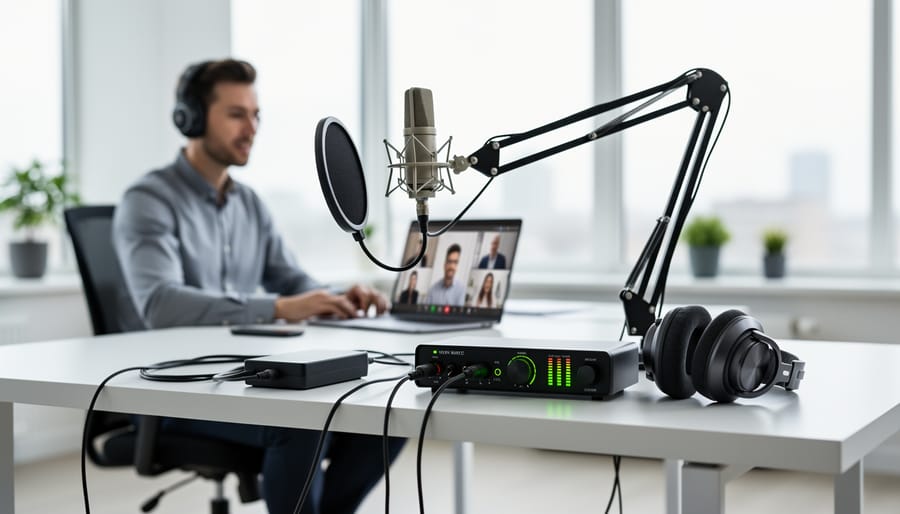
When evaluating business video conferencing systems, screen sharing and recording capabilities form the baseline. Any platform worth considering must offer reliable screen sharing with annotation tools, allowing presenters to mark up documents during discussions. Recording functionality is equally critical, not just for absent team members but for compliance documentation and training purposes. Look for automatic cloud storage rather than local-only recording, which creates version control headaches.
Participant management tools separate professional-grade systems from consumer platforms. You need the ability to mute participants, control who can share screens, create breakout rooms for group work, and manage waiting rooms to prevent unauthorized access. These controls matter most during client presentations or board meetings where interruptions undermine credibility.
- High-definition video quality (minimum 1080p) with automatic bandwidth adjustment
- Screen sharing with annotation and multiple screen support
- Cloud-based recording with searchable transcriptions
- Robust participant management including mute controls and waiting rooms
- Calendar integration with Outlook and Google Workspace
- Mobile apps that match desktop functionality
- 24/7 technical support with guaranteed response times
- End-to-end encryption and enterprise-grade security protocols
Calendar integration saves significant administrative time by allowing meeting links to populate automatically in scheduling systems. Mobile access has shifted from nice-to-have to essential, particularly for executives who join from airports or between appointments. The mobile experience should replicate desktop capabilities, not offer a stripped-down version.
Technical support deserves careful scrutiny. Free platforms typically offer community forums and email tickets. Business plans should include live support with measurable response times. For boardroom installations at venues like restaurants hosting corporate events, having a support contact who understands hardware integration prevents meetings from derailing when equipment fails.
Virtual backgrounds might seem cosmetic, but they serve practical purposes in home offices and protect privacy. Security features including end-to-end encryption, password protection, and compliance certifications (SOC 2, HIPAA where applicable) are non-negotiable for businesses handling sensitive information. Test these features during trial periods rather than discovering limitations after purchase.
How We Ranked the Best Options for Different Business Needs
We evaluated business video conferencing solutions by testing them against real-world scenarios that companies face daily. Our ranking methodology considers four primary dimensions that directly impact how well a system serves your specific needs.
Company size and structure forms the foundation of our assessment. A five-person startup requires fundamentally different capabilities than a multinational corporation with distributed teams. We tested each platform’s performance with varying participant counts, examining how smoothly systems handled everything from quick two-person check-ins to full department presentations with 50+ attendees. Solutions that maintained stable connections and clear audio across all size ranges scored higher.
Meeting frequency and patterns shaped our second evaluation criterion. If your team conducts brief daily standups, you need instant-access platforms that launch in seconds without complex setup procedures. Conversely, businesses hosting weekly client presentations in boardroom facilities benefit from systems offering advanced features like custom branding and professional recording capabilities. We mapped each solution against these usage patterns to identify where they excel.
Technical expertise available proved crucial during our testing. Some platforms require IT staff to manage backend systems and troubleshoot connectivity issues. Others work brilliantly for teams without dedicated technical support, offering intuitive interfaces and reliable automated updates. We assigned separate scores for technical complexity, allowing you to filter recommendations based on your internal capabilities.
Budget constraints and cost structure completed our framework. Beyond headline subscription prices, we calculated total ownership costs including hardware requirements, training expenses, and scalability charges. This revealed significant differences between apparently similar-priced options. A solution that seems expensive monthly might cost less annually than a “budget” platform requiring extensive hardware upgrades for your boardroom installations.
Recommendations by Business Type and Size
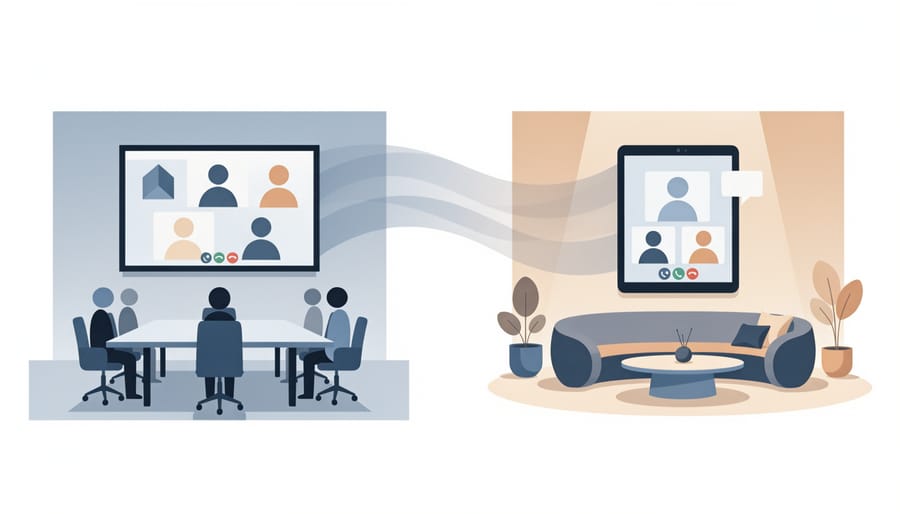
Small businesses and startups typically thrive with straightforward cloud-based platforms that charge per user monthly. Zoom or Google Meet provide sufficient functionality for team collaboration, client check-ins and basic presentations without requiring dedicated IT support. These solutions work well for companies up to 25 employees who conduct most meetings remotely and need mobile flexibility more than boardroom infrastructure.
Mid-size companies with 50 to 500 employees benefit from Microsoft Teams or Cisco Webex, which integrate deeply with enterprise email, calendar systems and document sharing. These platforms support larger participant counts, offer administrative controls for user management, and provide reliable uptime for client-facing presentations. Companies at this stage often invest in a single permanent conference room with a quality camera, microphone array and large display rather than equipping every space.
Enterprise organizations managing hundreds or thousands of employees across multiple locations need solutions like Zoom Rooms or Cisco Webex Boards paired with dedicated network infrastructure. These systems support simultaneous meetings across time zones, provide granular security controls, and integrate with existing authentication systems. Large corporations typically standardize on one platform to ensure compatibility, then equip multiple boardrooms and huddle spaces with appropriate hardware configurations.
Venue-based businesses like restaurants with boardroom facilities face unique requirements. An executive dining room that hosts corporate groups needs reliable plug-and-play systems that external clients can operate without venue staff intervention. Cloud platforms with wireless screen sharing work best here, paired with a permanently installed display and ceiling-mounted camera. Venues offering private dining during meetings should ensure video quality remains strong even when participants are seated around a table rather than facing a camera directly. The technology becomes an extension of hospitality, just like a carefully curated lunch menu standout that enhances the overall meeting experience for business clients.
Common Mistakes to Avoid When Buying Video Conferencing
The most expensive mistake companies make is choosing a video conferencing system based solely on headline features rather than testing how it performs in their actual environment. This oversight leads to wasted budget and frustrated teams who revert to consumer apps instead of the enterprise solution.
Bandwidth requirements catch many businesses off guard. A system might work flawlessly during a demo with a few participants, but struggle when ten people join from different locations while screen sharing runs simultaneously. Test your solution during peak network usage hours with realistic participant numbers before committing. Factor in upload speed as well, not just download capacity, since hosting requires substantial upstream bandwidth.
Audio quality deserves equal priority to video clarity. Many buyers fixate on camera resolution while accepting mediocre microphones and speakers, which creates a worse experience than decent audio with standard video. In boardroom settings especially, poor audio turns meetings into repetitive “can you hear me?” exchanges that waste everyone’s time.
- Underestimating bandwidth needs, test with realistic participant numbers during peak usage
- Skipping user training, even intuitive systems need structured onboarding for adoption
- Ignoring security protocols, verify encryption standards and access controls meet your requirements
- Choosing incompatible systems, confirm integration with calendar, email, and existing collaboration tools
- Prioritizing video over audio, invest in quality microphones and speakers first
- Buying without testing, run pilot programs in actual meeting scenarios before full deployment
Security protocols frequently get overlooked until after purchase. Verify that encryption standards meet your industry requirements, understand where meeting data gets stored, and confirm you can control guest access appropriately. A healthcare provider and a retail business face different compliance needs.
Integration compatibility matters more than most realize. Your video conferencing system needs to work seamlessly with existing calendar software, email clients, and collaboration platforms. If users must switch between five different apps to schedule and join meetings, adoption rates plummet regardless of video quality. Run integration tests with your specific tech stack, not the vendor’s demo environment.
Frequently Asked Questions
What internet speed do I need for business video conferencing?
For HD video calls, you’ll need minimum upload and download speeds of 3-4 Mbps per participant. Group meetings with multiple participants or screen sharing require 8-10 Mbps to maintain quality, while 4K video demands 15+ Mbps per user.
Do I need to buy special hardware for video conferencing?
Basic video calls work with just a laptop or smartphone, but dedicated boardrooms benefit from conference cameras, quality microphones, and display screens. The investment depends on meeting frequency, daily users justify professional equipment, while occasional needs can run on existing devices.
How can I secure business video conferences from unauthorized access?
Enable waiting rooms to screen participants before entry, require passwords for all meetings, and use unique meeting IDs rather than personal room links. Lock meetings once all expected attendees join and disable screen sharing for non-hosts.
Will video conferencing work across different devices and operating systems?
Most modern platforms support Windows, Mac, iOS, and Android, letting participants join from their preferred devices. Check that your chosen solution offers browser-based access for users who can’t install software on work computers.
What equipment should conferencing facilities install in boardrooms?
Professional meeting spaces need a wide-angle camera that captures the entire room, ceiling or tabletop microphones with echo cancellation, and a large display or projector for remote participants. Add HDMI connections for laptop sharing and reliable ethernet for bandwidth stability.
How much does business video conferencing cost per month?
Cloud platforms range from free basic plans to $15-30 per user monthly for professional features. Enterprise contracts with dedicated support and compliance tools start around $20,000 annually, while on-premise systems require upfront hardware costs between $5,000-$50,000 depending on room size.
These answers cover the technical and practical concerns most businesses face during selection. Companies hosting regular client meetings in boardroom facilities should prioritize the hardware question, since professional equipment directly impacts the impression you make on remote participants. Restaurants like Havana Lunch that offer boardroom spaces for corporate events can differentiate their services by ensuring reliable connectivity and quality audio-visual setups that eliminate technical frustrations.
Budget considerations extend beyond subscription fees. Factor in one-time setup costs, employee training time, and ongoing internet capacity upgrades when calculating total investment. Testing your selected platform with a small group before company-wide rollout prevents expensive mistakes and identifies compatibility issues early.
Selecting the right business video conferencing solution comes down to matching technology with your actual needs, not chasing every available feature. Start by honestly evaluating how your teams work: the size and frequency of your meetings, whether participants join remotely or gather in boardrooms, and what integration points matter most for your existing workflows.
The best video conferencing setups balance three elements: reliable technology that works consistently, intuitive interfaces that minimize training overhead, and sufficient flexibility to adapt as your business evolves. Whether you opt for cloud-based simplicity, on-premise control, or a hybrid approach, prioritize solutions that your team will actually use rather than impressive specs that sit idle.
For businesses that host client meetings or rely on professional conferencing facilities, video technology has become as essential as comfortable seating and quality catering. Modern venues like Havana Lunch demonstrate this integration effectively, combining well-equipped boardrooms with both in-person hospitality and seamless digital connectivity for hybrid meetings. This approach recognizes that today’s business conversations often blend remote participants with on-site attendees.
Take time to test systems with your real meeting scenarios before committing. The right video conferencing investment should simplify communication, strengthen collaboration, and support your business goals without creating new technical burdens.